Before I open a client's session, I listen to my references. I've done this almost every working day for over two decades. I think it's good practice, but it all started with a school assignment.
The Assignment
When I was in the Sound Recording Technology program at Texas State, our first freshman lab assignment was to burn an audio CD. The assignment had a specific constraint: every track had to come from Bob Katz's Honor Roll.
If you're not familiar with Bob Katz, he's a mastering engineer and the author of Mastering Audio (a book I still use when I teach mastering today). The Honor Roll is his curated list of recordings he considers exceptionally well recorded. What made it particularly relevant at the time was that Katz also categorizes these recordings by their absolute level. This was the early 2000s, deep in the heart of the loudness wars, when heavy limiting and hyper-compressed masters were the norm and a constant topic in audio engineering programs. The Honor Roll was a counter-argument in list form.
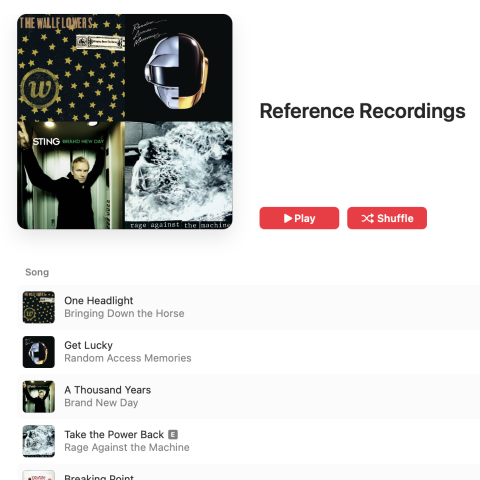
I grew up in the mixtape era, so choosing songs and putting them on media wasn't foreign to me. I took the assignment seriously. The first track I chose was "One Headlight" by The Wallflowers. The disc had ten tracks total.
I carried that disc in my backpack to every room I worked in at school and beyond. Almost without fail, I listened to at least one song before starting any session. In those days, almost every room I worked in had a cd player hooked up to something like the aux 2-track on the console. So, popping in a CD, clicking the 2-track button, and setting monitor levels was an easy quick start to my setup. I'd listen while continuing on other setup like patching mics or outboard gear from notes or something like that.
The Same First Track
The disc eventually made its way with me to Terra Nova, where I copied the playlist into an Alesis Masterlink. Later it became an Apple Music playlist. Over the years, a few songs have come and gone, but "One Headlight" remains the first track on my reference playlist.
What I'm doing when I put it on isn't nostalgic. Well, it's not just nostalgic, it's functional. It's calibration, a morning ritual, it's how I start my day. Some start with coffee, most days I start with "One Headlight." This way, when I start a session, especially in a room I'm less familiar with, I start knowing what right sounds like in this room, on this day, on these speakers. By the time the song ends I have a baseline. I know where I am. Then I get to work.
The First Listen
The first listen to a new mix is not about processing decisions. Nothing gets touched. First I need an understanding of what the music is doing and what it's trying to be before I have any opinion about what it needs.
Here's what I'm specifically listening for.
Tonal Balance
The first thing that registers is where the weight of the mix lives. Is this a record that sits in the low mids? Does it feel bright or dark? Is there a frequency range asserting itself in a way that might be the mix's character, or might be the room it was made in?
A mix that feels thick and warm might be exactly right for the music, or it might be a room problem that needs addressing. At this stage I'm building a tonal picture of the record before I've touched anything.
Low-End Behavior
The bottom of a mix tells me a lot early. What's the relationship between the kick and the bass? Does the low end feel controlled, or are certain frequencies moving around in a way that suggests something is fighting? Is the sub content sitting where it should, or spreading in a way that might cause problems on different playback systems?
Low end is also where room problems show up most clearly. A mix made in a room with a buildup or deficiency in the bass frequencies creates problems for the mix. Sometimes it sounds natural in that room and odd everywhere else. I'm listening for that type of problem, not to judge the mix engineer, but to help the mix be the best mix possible.
Dynamic Relationships
How does the mix breathe? Is there real contrast between the verse and the chorus, or does the whole record sit at the same level? Are the transients (the attack of a snare, the front edge of an acoustic guitar strum) alive and present, or has the processing chain softened them?
A mix with genuine dynamic contrast gives me options. A mix that's already been flattened by heavy limiting gives me fewer tools to shape the master. I'm not making a judgment about that yet, I'm taking stock of what I'm working with and what the session is likely to need.
Intent and Execution
By the end of the first two minutes, I have a working theory about what this record is trying to be. Sometimes that comes from the artist's notes or a reference track they've sent. Often I hear it directly: this is a dense, physical record that wants to hit hard; this is a sparse, emotionally direct record that wants to feel intimate; this is a raw live recording that should feel slightly uncontrolled.
What I'm listening for is where the mix is already doing that well, and where the distance between intent and execution is largest. That gap is usually where mastering has the most to offer. I'm not necessarily correcting mistakes, but closing the distance between what the artist intends and what the listener will actually hear.
Why This Matters
If you're sending work to mastering, understanding this process is worth something. The clearer you can make the intent of the record, whether in notes, in references, or in a brief conversation before the session, the faster I can close that gap. When I can confirm what I'm hearing rather than spending time figuring it out, the session goes better.
Every session starts the same way. Listen first; then work.